Calibration Techniques for Ensuring Accuracy in Temperature Controllers
Understanding Process Temperature Controllers
Overview of Temperature Control
Engineers deploy a process temperature controller to regulate heat in manufacturing lines, chemical reactors, and food processing equipment. These devices compare measured temperature against a set value and adjust heaters or coolers accordingly. Modern units handle everything from simple on-off switching to sophisticated loops that maintain stability within fractions of a degree. Operators gain reliable performance when they match controller capabilities to the thermal mass of the system. Integration with automation platforms allows remote monitoring and rapid response to load changes. Proper selection prevents overshoot, reduces energy waste, and extends equipment life across continuous operations. In high-volume extrusion lines, for instance, controllers must accommodate rapid throughput changes while compensating for ambient temperature fluctuations that affect barrel heating zones. Advanced models incorporate adaptive algorithms that continuously refine control parameters as material properties shift, ensuring consistent melt temperatures critical for product dimensional accuracy.
Importance of Precision in Temperature Measurement
Precision in temperature measurement directly affects product quality and process safety. A process temperature controller relies on accurate sensor data to keep reactions within tight tolerances. Small deviations can alter viscosity, cure rates, or microbial kill steps. Facilities achieve consistent output by calibrating sensors regularly and verifying readings against traceable standards. Infrared options speed non-contact checks during maintenance, while contact probes deliver data for closed-loop control. High-accuracy measurement also supports regulatory compliance in pharmaceutical and aerospace applications where every degree matters. In semiconductor wafer processing, temperature variations exceeding 0.5 °C can cause dopant diffusion errors that scrap entire batches. Traceability to national standards such as those maintained by NIST ensures that measurement chains remain defensible during audits and liability reviews.
Introduction to PID Control in Temperature Regulation
PID control forms the backbone of most process temperature controller designs. Proportional action responds to current error, integral action eliminates steady-state offset, and derivative action anticipates future changes. Technicians tune these three terms to match heater power, thermal lag, and disturbance frequency. Well-tuned PID controllers reduce settling time and minimize oscillations that waste energy. Many units now offer auto-tune routines that calculate gains automatically during startup. This approach simplifies commissioning while delivering stable temperature control across varying production rates. Ziegler-Nichols and Cohen-Coon methods remain popular manual tuning strategies, yet modern controllers embed relay-based or model-predictive auto-tuning that accounts for nonlinear heater characteristics and variable thermal loads without requiring process shutdowns.
Calibration Techniques for Temperature Controllers
Fundamentals of Calibration
Calibration aligns the process temperature controller output with known reference values. Technicians apply stable temperature points across the operating range and record deviations. They then adjust zero, span, or linearization constants inside the controller. Regular calibration counters sensor drift caused by aging, vibration, or contamination. Documentation of each session supports quality audits and traceability requirements. Effective calibration programs schedule checks based on usage intensity and environmental severity rather than fixed calendars alone. Risk-based intervals derived from historical drift data often extend calibration cycles for stable installations while tightening them for sensors exposed to corrosive atmospheres or mechanical shock.
Common Calibration Methods
Common methods include ice-point baths, dry-block calibrators, and stirred liquid baths. Each method creates repeatable temperature references that technicians compare against controller readings. Multi-point calibration checks linearity, while single-point verification confirms offset at the most critical operating temperature. Some facilities use comparison techniques that reference a certified standard thermometer alongside the installed sensor. These approaches ensure the entire measurement chain from probe to display maintains specified accuracy for industrial temperature controls. Dry-block units offer portability for field service, whereas stirred baths provide superior uniformity when calibrating multiple sensors simultaneously in laboratory settings.
Using Thermocouples for Accurate Temperature Measurement
Thermocouples remain popular because they cover wide temperature ranges and respond quickly. A process temperature controller accepts thermocouple inputs after proper cold-junction compensation. Technicians verify extension wire polarity and connection integrity during calibration. Type K and Type J sensors dominate most heater control equipment, yet each requires specific linearization tables inside the controller. Regular checks against fixed-point cells or calibrated dry blocks confirm that thermocouple degradation has not introduced unacceptable error in temperature measurement. Mineral-insulated designs resist vibration better than beaded-wire constructions, while noble-metal types such as Type S or R extend service life above 1000 °C where base-metal sensors oxidize rapidly.
Types of Temperature Controllers
Panel-Mount vs. DIN-Rail Controllers
Panel-mount controllers fit standard cutouts in control cabinets and provide clear local displays for operators. DIN-rail controllers mount on 35 mm rails inside enclosures, saving panel space in dense automation systems. Both styles deliver identical PID functionality, yet panel-mount units often include larger screens and more front-panel buttons. DIN-rail versions emphasize compact size and modular expansion. Facilities choose between 16 DIN and 32 DIN sizes depending on available mounting area and required I/O density for process temperature controller installations. Hybrid designs now combine DIN-rail mounting with detachable operator interfaces that can be located remotely on machine doors for improved ergonomics.
Overview of Surface-Mount Control Options
Surface-mount control options place the process temperature controller directly on machine frames or walls. These units withstand vibration and wash-down environments when sealed properly. Installers appreciate quick wiring access and the absence of panel cutouts. Many surface-mount models incorporate configurable inputs and outputs that adapt to different sensor types without additional hardware. This flexibility suits retrofit projects where space constraints rule out traditional panel or DIN-rail mounting styles. IP67-rated enclosures with integrated cable glands further simplify installation in outdoor or high-humidity processes such as composite curing ovens.
Exploring PC-Programmable Controllers
PC-programmable controllers let engineers configure PID parameters, alarm thresholds, and communication settings through software rather than front-panel menus. A process temperature controller with this capability reduces setup time during line changes. Users download recipes, log historical data, and perform firmware updates over Ethernet or USB links. The approach also supports simulation of control loops before hardware installation, minimizing commissioning risk in complex industrial temperature controls. Parameter cloning across multiple units via USB flash drives accelerates changeovers in multi-zone heat-treat furnaces where identical recipes must be replicated quickly.
Advanced Features and Connectivity
Integration of RS-485 and Modbus in Temperature Controllers
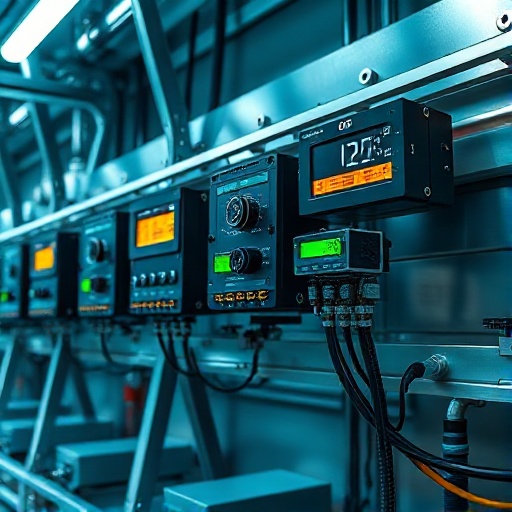
RS-485 networks enable multiple process temperature controller units to share a single twisted-pair cable with a central PLC or SCADA system. Modbus protocol standardizes data exchange for setpoints, process values, and diagnostics. Engineers configure node addresses and baud rates once, then monitor every controller from a single workstation. This connectivity reduces wiring costs and supports predictive maintenance by streaming real-time temperature measurement data into historian databases. Modern implementations also support Modbus TCP over Ethernet, enabling seamless integration with plant-wide information systems without additional gateways.
Configurable Inputs and Outputs for Enhanced Control
Configurable inputs and outputs allow one process temperature controller to accept thermocouples, RTDs, or voltage signals without hardware changes. Outputs can drive solid-state relays, analog valves, or alarm contacts. Users map each terminal through menu selections or software, adapting the same unit across different heater control equipment. This versatility lowers inventory requirements while maintaining precise temperature control in varied applications. Universal input modules further reduce spare-parts logistics by supporting 0–10 V, 4–20 mA, and resistance inputs on the same terminals.
Humidity and Pressure Measurement Considerations
Many processes require simultaneous tracking of humidity and pressure alongside temperature. Advanced controllers accept auxiliary sensors for these variables and incorporate them into cascade or feedforward strategies. A process temperature controller that monitors relative humidity helps prevent condensation in drying ovens. Pressure data supports vacuum or pressurized vessel control. Integrated measurement reduces the need for separate instruments and simplifies automation architecture. In pharmaceutical lyophilization, coordinated control of shelf temperature, chamber pressure, and condenser load ensures consistent sublimation rates and product potency.
Choosing the Right Process Temperature Controller
Factors to Consider for Industrial Applications
Industrial applications demand controllers rated for the expected ambient temperature, electrical noise, and vibration. Engineers evaluate input resolution, output power, and communication options before selecting a process temperature controller. They also consider future expansion needs and spare parts availability. Matching controller features to process dynamics avoids both underperformance and unnecessary expense in heater control equipment. Electromagnetic compatibility ratings and surge-withstand capability become decisive when controllers share panels with variable-frequency drives or welding equipment.
Comparing PID Controllers for Specific Needs
PID controllers differ in autotune quality, cascade capability, and ramp-soak programming. Some units excel at fast thermal response in packaging machines, while others stabilize large furnaces with significant lag. Comparing PID controllers side by side reveals differences in overshoot suppression and disturbance rejection. Facilities test candidate units on pilot equipment to confirm performance before full-scale deployment of any process temperature controller. Criteria such as integral windup prevention and bumpless transfer between manual and automatic modes further differentiate premium models in demanding batch processes.
Evaluating Heater Control Equipment for Various Settings
Evaluating heater control equipment requires attention to power handling, sensor compatibility, and environmental sealing. A process temperature controller paired with the correct solid-state relay or contactor delivers reliable switching without excessive wear. Installers verify that mounting style, display readability, and network support align with site standards. Thorough evaluation prevents downtime and ensures consistent temperature control across batch and continuous processes. Lifecycle cost analysis that includes calibration labor, spare parts, and mean time between failures often favors controllers with extended warranties and remote diagnostic capabilities.